Nestled in the quiet town of Jingchuan (泾川), Dayun Temple (大云寺) is a place even most Chinese people have never visited. Though little known today, this region once held immense strategic and cultural significance. As the first major military outpost on the route from Chang’an to the Western Regions, it was a bustling hub on the Silk Road. Both the Sui (隋) and Tang (唐) imperial families built pagodas and temples here, and over the centuries, it became home to the earliest and largest collection of Buddhist relics ever unearthed in China.
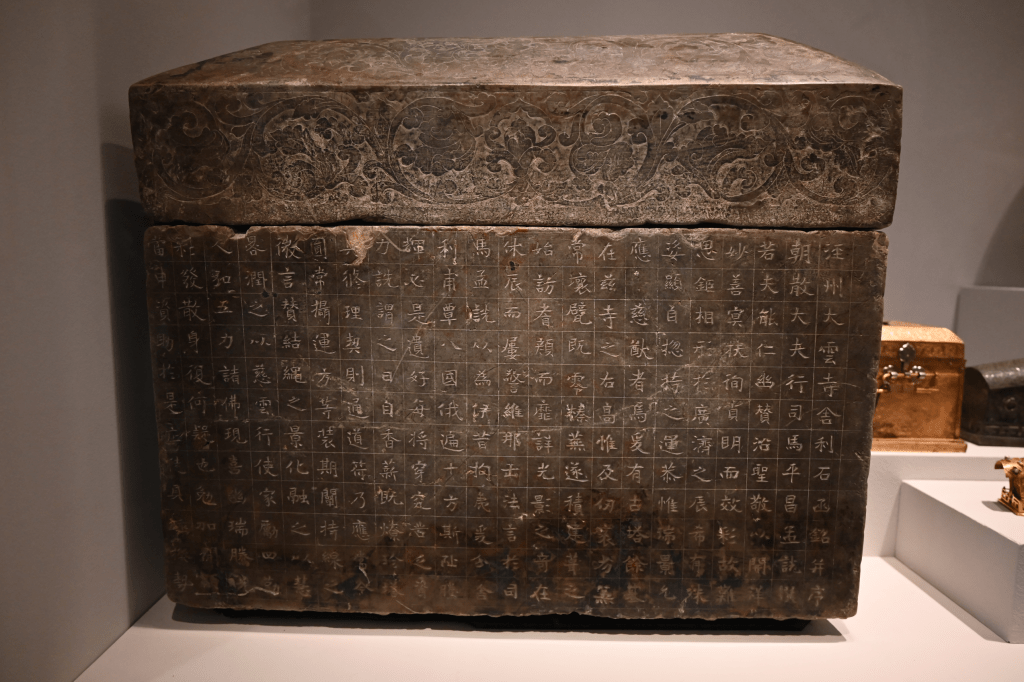
One of its most remarkable discoveries is a stone reliquary that tells a fascinating story of how Buddhism adapted to Chinese traditions. Unlike the Indian custom of enshrining relics in pagodas, this one was buried like a coffin, a major shift in Buddhist practices. Commissioned by the royal court, it showcases exquisite craftsmanship. But what makes it truly invaluable is the inscription carved onto its surface, listing the names of officials and monks involved in the ritual. with a clear annual mark of the first year of YanZai (延载元年). This rare historical record offers a glimpse into life in the 7th century, bridging faith, politics, and culture.
The first layer is made by hard, grey marble, inscribed with Zhou Jingchuan Dayun Temple Reliquary with a total of 14 relics (大周泾川大云寺舍利之函总一十四粒) . The surrounding is decorated by twisted western passionflower motifs.

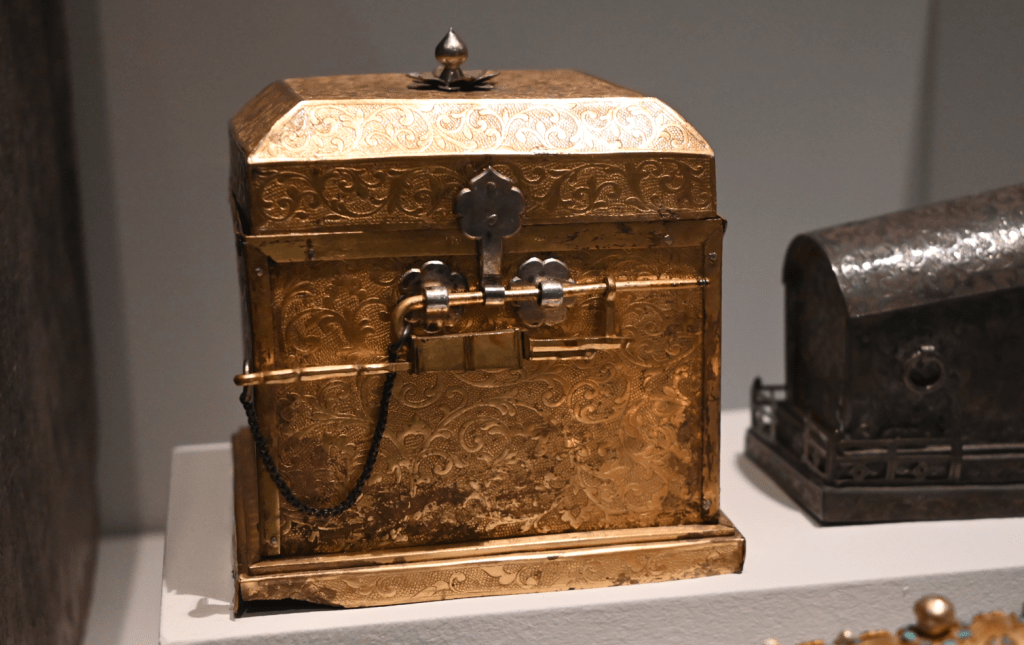
The second layer is a copper box, similar in shape to the stone reliquary, and entirely gilded. It is engraved with a honeysuckle pattern. The lid is adorned with a silver 12-petal lotus, with a peach-shaped silver bead at its center. Between the lid and the body, on the back, are two silver hinges, while the front features three petal-shaped silver buckles along with a gilt copper padlock.
The second layer is a copper box, similar in shape to the stone reliquary, and entirely gilded. It is engraved with a honeysuckle pattern. The lid is adorned with a silver 12-petal lotus, with a peach-shaped silver bead at its center. Between the lid and the body, on the back, are two silver hinges, while the front features three petal-shaped silver buckles along with a gilt copper padlock.
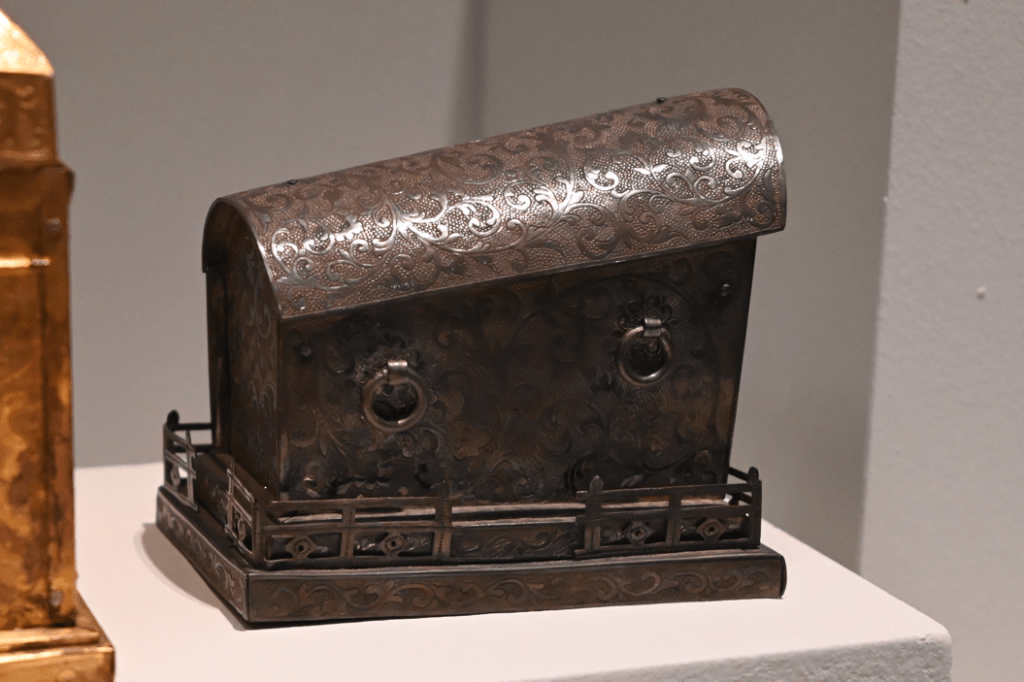
The third layer is a silver coffin with a tiled cover, engraved with intertwined honeysuckle patterns. Both sides have two circular rings, and the rectangular base is surrounded by hook-like railings with embedded diamond patterns.
The fourth layer is a gold coffin, similar in shape to the silver one. Its lid and body are inlaid with gold sheets, pearls, and turquoise, forming a large lotus design, with additional small lotuses ornamenting its perimeter.

Inside the gold coffin lies a small sandalwood partition that holds a white, transparent glass bottle—long-necked, round-bellied, and flat-bottomed. This bottle contains 14 relics that are as small as grains of rice and as lustrous as pearls. However, I didn’t find it in the display case at the exhibition.

When I visited the Tang China: A Cosmopolitan Dynasty exhibition at the Guimet Museum in Paris in February 2025, this masterpiece immediately caught my eye. It brought me back to my trip to Dayun Temple in 2019. Once a bustling hub in history, it now feels quiet and almost forgotten. Most locals visit to worship and seek the blessings of Buddha, but the deeper significance of the reliquary seems to exist only in museums. This artifact has traveled the world, previously displayed in the UK, Switzerland, Singapore, and other locations, before finally returning to its home at the Gansu Provincial Museum.


 Veni VEDI Voravi
Leave a comment